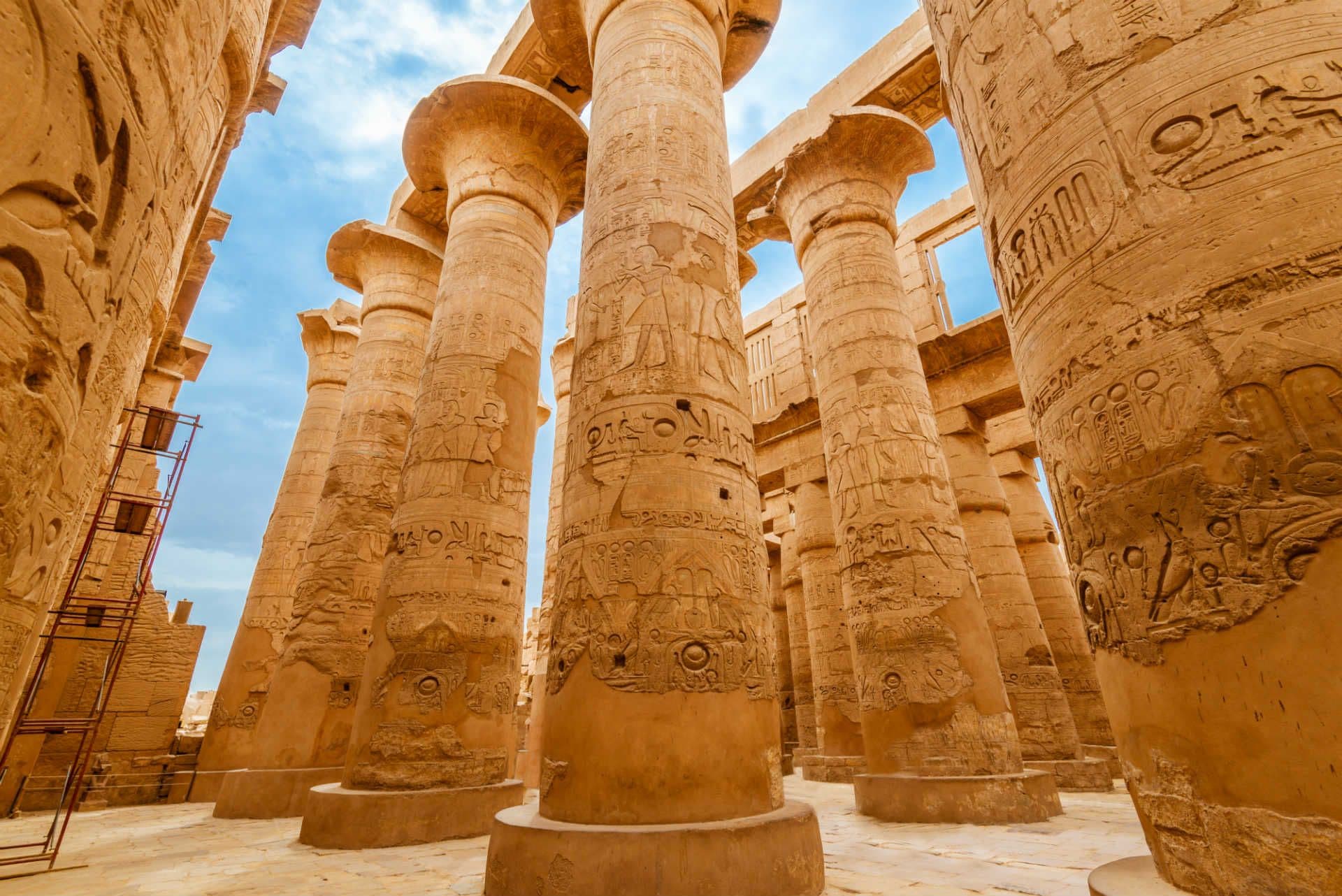
Luxor is where ancient Egypt stops being history and starts being a place you are actually standing in.
The city occupies the site of ancient Thebes — capital of the New Kingdom, home of the pharaohs for over a thousand years, the city from which Egypt reached its greatest territorial extent and built its most enduring monuments. The scale of what remains is genuinely difficult to process on arrival. Within a few kilometres of the city centre: two of the largest temple complexes ever built, the burial ground of the pharaohs, hundreds of painted tombs, and a landscape that has looked roughly the same since the time of Ramesses II.
Luxor divides along the Nile. The East Bank is the city of the living — modern Luxor, the hotels, the souq, Luxor Temple, and Karnak. The West Bank is the city of the dead — the Valley of the Kings, the Valley of the Queens, Hatshepsut's temple, the workers' village of Deir el-Medina, and the two vast seated figures of the Colossi of Memnon marking the entrance to a mortuary temple that has otherwise vanished. The ancient Egyptians understood the geography: the sun rises over the East Bank and sets behind the West Bank cliffs. Life and death, ordered by the horizon.
Three nights is the right amount of time. Two days is enough to see the major sites; the third day is for going slower, returning to what surprised you, and crossing to the West Bank on the local ferry at dawn without a plan.
What nobody tells you
The sequencing matters more than the time. Valley of the Kings and Hatshepsut on the same West Bank morning; Karnak at opening, Luxor Temple at night — this is the rhythm that makes Luxor work. Doing it the other way, or cramming everything into one day, produces exhaustion rather than understanding.
The tombs vary enormously in quality. The standard Valley of the Kings ticket includes three tombs, and the difference between a spectacular one and a mediocre one is significant. Do not let your driver or a tour operator choose for you — read the descriptions, know which ones are open, and choose based on what interests you. The extra ticket cost for the outstanding ones is trivial.
Luxor in summer is extreme. June through August temperatures regularly exceed 42°C. The ancient sites are largely unshaded. If you are visiting in summer, the sites must be done before 9am and after 5pm — everything in between should be spent horizontal under air-con. This is not a complaint; it is logistics.
The local ferry is one of the best things in Luxor. EGP 5, five minutes across the Nile, with the West Bank cliffs ahead of you and the East Bank minarets behind. It runs continuously from dawn to late evening. Take it instead of the tourist ferry whenever you can — you will share it with schoolchildren, farmers, and women carrying shopping, which is a more accurate version of Luxor than the cruise ship gangway.