
EgyptBound
EgyptBound
Insider
Chat on WhatsApp

© 2026 EgyptBound. All rights reserved.

Egypt insider travel · 2026

AlexandriaEgypt's Mediterranean Secret — Layered, Coastal, and Completely Itself

Alexandria is what happens when Egypt meets the sea — and four thousand years of history decide to stay for the view.

Alexandria is the city most visitors to Egypt never reach, and almost everyone who does reach it wishes they had come sooner. Two hours from Cairo by train, it operates at a completely different frequency — salt air, art-deco facades, the best seafood in Africa, and a layered history that runs from Alexander the Great through Napoleon to a thriving contemporary art scene. This guide covers how to actually experience it, not just tick it off.

Best timeApril to June, September to November
VibeMediterranean, Nostalgic, Literary, Coastal
Price range$$ - Affordable Luxury
Ideal forHistory Buffs, Foodies, Architecture Lovers, Literary Travellers

Travellers often pair this with:

Alexandria, Egypt
Verified 2026
Best month to visit
October
Crowd level
Budget per day
$35–75
Days recommended
2–3 nights
The inside story

Editorial guide — updated for how travellers actually move through the city today.

Alexandria is what happens when Egypt meets the sea — and four thousand years of history decide to stay for the view.

The city that Alexander the Great founded in 331 BC, that Cleopatra ruled, that housed the greatest library in the ancient world, that Napoleon tried to hold and failed, that Lawrence Durrell wrote four novels about, that the Greek and Jewish and Arab and Italian communities made into the most cosmopolitan city in Africa — that city is still here, layered under and alongside the modern Egyptian port town of five million people.

Most tourists to Egypt miss Alexandria entirely. Cairo to Luxor to Aswan is the standard route, and it is a good route. But Alexandria is a different register of experience — slower, more European in its bones, melancholy in a way that is specific to cities that were once the centre of the world and have made a certain peace with no longer being so.

Two days here is enough to understand why people come back. Three is enough to feel the rhythm of the place. More than that and you will find yourself thinking about returning before you have left.

What nobody tells you

The food is the best argument for coming. Alexandria's position on the Mediterranean means the seafood is fresher than anywhere inland in Egypt, and the city's layered cultural history — Greek, Italian, Jewish, Arab — produced a local cuisine that is genuinely distinct from Cairo. The ful here is cooked differently. The pastries have a Greek grandmother somewhere in their ancestry. The fish is caught that morning.

The sea is not always swimmable. The Mediterranean off Alexandria is beautiful to look at and polluted in ways that make swimming inadvisable near the city centre. Go to Montazah or further east for clean water. Do not swim off the Corniche.

The nostalgia is real but also constructed. Alexandria trades partly on its reputation as the city of Cavafy and Durrell and a lost cosmopolitan past. That past was also a colonial one, and the city that exists now — Arabic, Egyptian, busy, alive — is not a diminished version of what came before. It is what came after. Engage with both.

Curated by locals

Top experiences in Alexandria

Real picks from the ground — not a checklist copied from a decade-old guidebook.

The Bibliotheca Alexandrina
01Best time · April to June, September to NovemberEntry · EGP 70 adults (~$1.50) — photography permit extra

The Bibliotheca Alexandrina

The modern Bibliotheca Alexandrina sits on the presumed site of the ancient Library of Alexandria — the greatest repository of knowledge in the ancient world, destroyed in circumstances still debated by historians. The building itself, designed by the Norwegian firm Snøhetta and opened in 2002, is an architectural event: a massive tilted disc of grey Aswan granite, its roof angled toward the Mediterranean like a sundial. Inside, the main reading hall descends eleven levels below street level and holds eight million books. Several museums occupy the same complex, including a Manuscript Museum, Antiquities Museum, and a permanent collection of rare maps of Alexandria through history.

EgyptBound insider

Most visitors spend 45 minutes looking at the exterior and the main hall and leave. Buy the combined museum ticket and go down into the Antiquities Museum — it holds a genuinely extraordinary collection of Greco-Roman objects, many excavated from the harbour floor, that would be headline exhibits in any European museum. Almost nobody goes there. You will often have entire rooms to yourself.
Add to my itinerary →
The Corniche — from Raml to Montazah
02Best time · April to June, September to NovemberEntry · Free

The Corniche — from Raml to Montazah

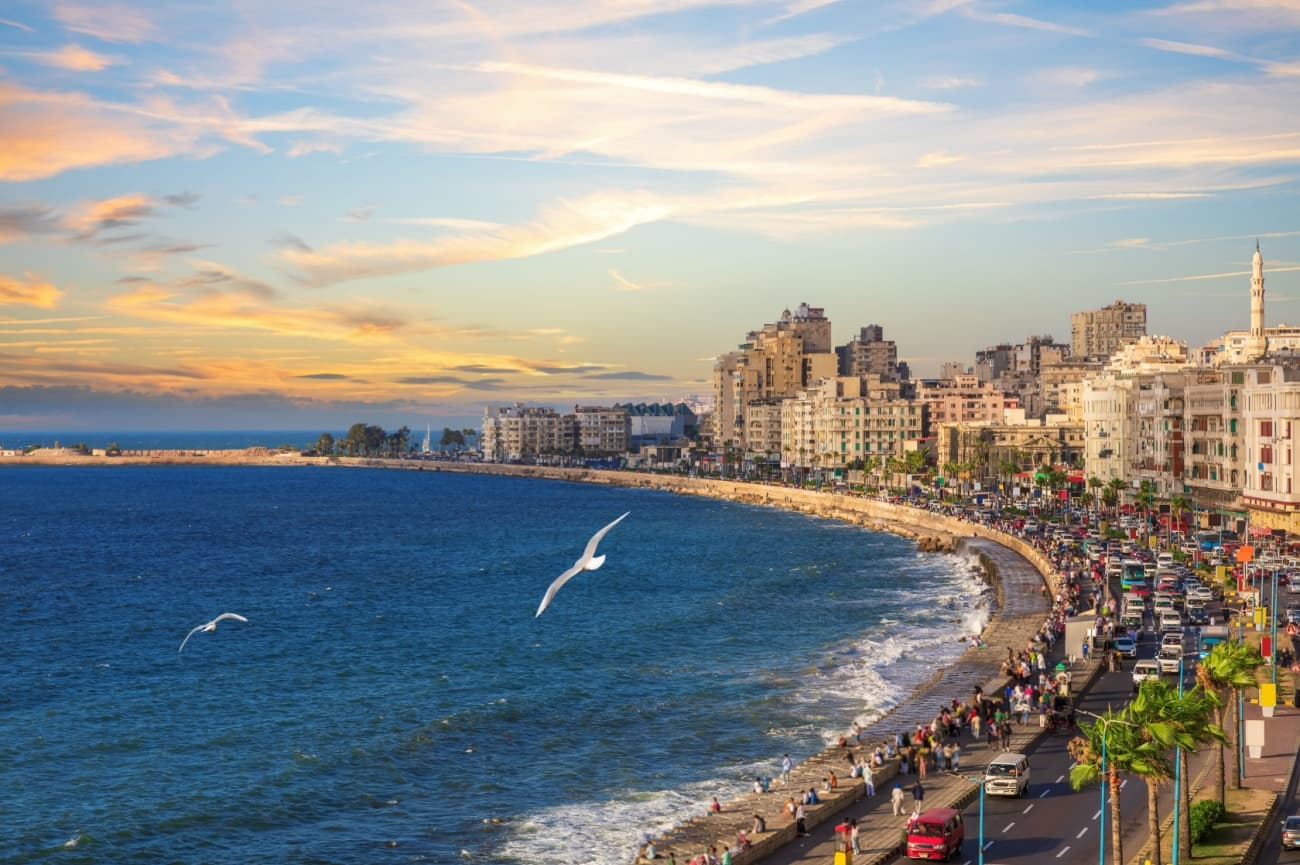
The Corniche is Alexandria's defining public space — a 20-kilometre seafront boulevard that runs the entire length of the city from Raml Station in the centre to the Montazah Palace gardens in the east. Walking even a section of it in the early morning or evening reveals the texture of Alexandrian daily life: fishermen casting from the seawall, old men playing backgammon at cafe tables, families occupying every bench, the smell of salt and bread and diesel in roughly equal measure. The art-deco and neo-classical facades behind the boulevard are some of the finest surviving examples of early 20th-century Mediterranean urban architecture anywhere.

EgyptBound insider

Walk east from Raml Station toward Sidi Gaber in the early morning — roughly 4km — and you see the city before it has fully woken up. The light on the water before 8am is extraordinary. Stop at any of the small bakeries one street back from the sea for a fresh feteer or sesame bread with white cheese. This is what Alexandrians eat for breakfast and it costs under EGP 20.

Add to my itinerary →
Catacombs of Kom el-Shoqafa
03Best time · April to June, September to NovemberEntry · EGP 180 (~$3.70)

Catacombs of Kom el-Shoqafa

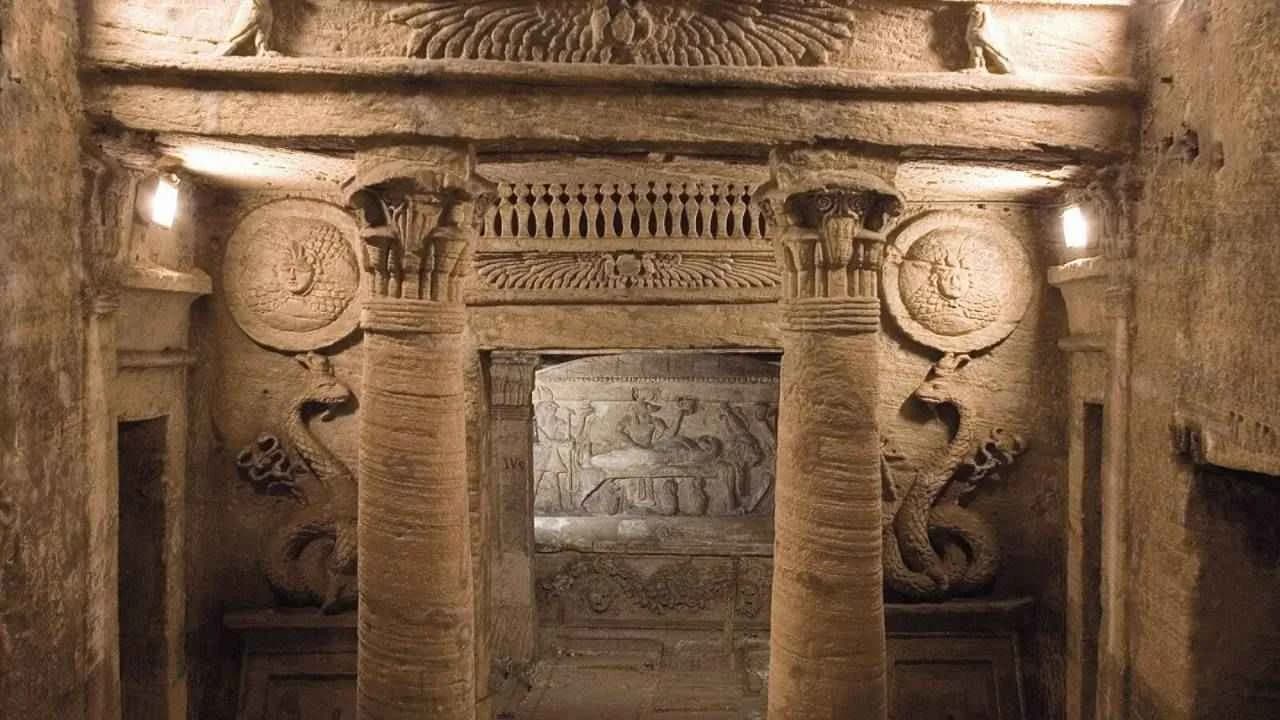
The Catacombs of Kom el-Shoqafa are the largest known Roman funerary complex in Egypt and one of the Seven Wonders of the Middle Ages — a designation that has not inflated their actual strangeness. Discovered accidentally in 1900 when a donkey fell through the ground into the first shaft, they descend three levels into the earth and hold a remarkable fusion of Egyptian, Greek, and Roman funerary iconography: Anubis wearing Roman armour, Greek columns carved in Egyptian rock, sphinxes flanking Roman niches. The hybrid visual language of the 2nd century AD, when three civilisations were actively negotiating the same space, is unlike anything else in Egypt.

EgyptBound insider

The lowest level floods seasonally and may be closed — check on arrival. The Triclinium on the second level, a banquet hall where families dined with their dead, is the most atmospheric space in the complex and usually uncrowded. Bring a small torch — some of the carved details in the niches are not well lit by the installed lighting.

Add to my itinerary →
Qaitbay Citadel
04Best time · April to June, September to NovemberEntry · EGP 120 (~$2.50)

Qaitbay Citadel

The Citadel of Qaitbay stands on the exact site of the ancient Lighthouse of Alexandria — one of the Seven Wonders of the Ancient World — on a narrow promontory at the western edge of the Eastern Harbour. Built in 1477 by Sultan Qaitbay using stones from the collapsed lighthouse, it is the most visually striking building in Alexandria and one of the best surviving Mamluk fortresses in the Mediterranean. The views from the upper battlements take in the full arc of the Eastern Harbour, the Corniche stretching east, and on clear days the open sea to the north.

EgyptBound insider

Walk around the outside of the Citadel rather than going straight inside — the fishermen's harbour on the western side is one of the most photogenic spots in the city, with brightly painted wooden boats moored below the fortress walls. In the late afternoon, the light on the stone turns the colour of old honey. The interior museum is modest; the exterior and the views are the point.

Add to my itinerary →
Stanley Bridge & Montazah Gardens
05Best time · April to June, September to NovemberEntry · Montazah gardens entry EGP 35 — palace exterior only

Stanley Bridge & Montazah Gardens

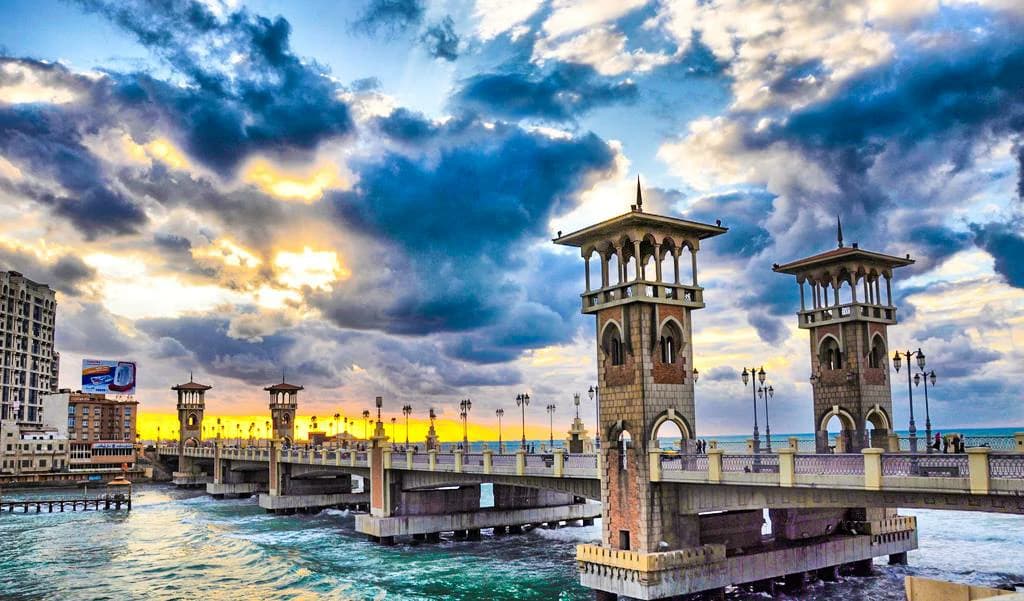
Stanley Bridge is Alexandria's most photographed landmark — a series of white arches spanning a bay on the eastern corniche, with the sea visible through each opening. It is purely decorative and entirely photogenic. A 10-minute tuk-tuk ride further east brings you to the Montazah Palace complex: a 150-acre garden of pine and palm trees built by Khedive Abbas II in 1892, overlooking a private bay. The palace itself is closed but the gardens are open and offer the best picnic spot in Alexandria — quiet, shaded, and surrounded by the sea on three sides.

EgyptBound insider

The small public beach at Montazah is one of the few genuinely swimmable beaches close to the city centre — calm water, relatively clean, and far less crowded than the beaches at Agami or Sidi Bishr. Go on a weekday. In summer it fills with Cairene families escaping the inland heat; in October you can have long stretches almost to yourself.

Add to my itinerary →
City intelligence

What you need to know before Alexandria

Honest framing — the annoying bits and what actually works.

Getting there

The fastest and most comfortable way from Cairo is the Spanish high-speed train (Talgo) from Ramses Station — 2 hours, roughly EGP 120–180 ($2.50–3.75) in second class, EGP 250–350 in first. Buy tickets at the station or through the Egyptian National Railways app. Regular intercity trains also run frequently and cost EGP 40–80 — slower (2.5–3hrs) but fine. Do not take a shared taxi or microbus from Cairo; the road journey is significantly longer. Alexandria has its own airport (HBE, Borg El Arab) with limited direct international connections — most travellers fly into Cairo and train from there. From the train station (Misr/Ramses Alexandria or Sidi Gaber), use a metered taxi or Uber to your hotel.

Getting around

Uber works reliably throughout Alexandria and is the recommended option for cross-city journeys. The blue trams (the oldest operating tram network in Africa, running since 1863) cover the central corniche and eastern neighbourhoods for EGP 3–5 per ride — slow but atmospheric and worth taking once. Tuk-tuks fill the gaps for short hops (EGP 15–30). The city is long and narrow — stretching 40km along the coast — so distances between the Citadel in the west and Montazah in the east are significant; budget time accordingly. Walking the corniche is the best way to experience the city centre; most major sights in the historic core are within 20 minutes on foot of each other.

Safety & scam radar

  • Unofficial 'guides' at the Catacombs and Citadel — both sites have clear signage and do not require a guide. Politely decline anyone who approaches you at the entrance.
  • Taxi drivers at the train station who quote in dollars — the correct fare to any central hotel is EGP 60–120. Use Uber from the moment you arrive.
  • Seafood restaurants on the corniche that do not display prices — ask for the menu with prices before sitting down. The 'market price' conversation at the end of the meal is a well-established practice in tourist-facing restaurants.
Full safety guide →
Accommodation

Where to stay in Alexandria

Three honest tiers — search opens in a new tab on Hotellook.

Under $35/night

Budget

Downtown / Raml Station area

The downtown area around Raml Station has several well-reviewed budget hotels in older buildings with high ceilings, central location, and walking distance to the Corniche and the Bibliotheca. The neighbourhood is lively and safe. Avoid the absolute cheapest options near the main bus terminal — the area is fine but the accommodation quality drops sharply below a certain price point.

EgyptBound pick: Hotel Union

Search budget hotels →
$35–100/night

Mid-range

Corniche / Stanley

Mid-range in Alexandria means sea views, reliable air-con, and a proper breakfast. The corniche-facing hotels in the Stanley and Rushdi neighbourhoods offer the best balance — quieter than downtown, walkable to the best restaurants, and with the sea immediately outside. A room with a direct sea view is worth the small premium.

EgyptBound pick: Steigenberger Cecil Hotel

Search mid-range hotels →
$100+/night

Luxury

Corniche / Montazah

Alexandria's luxury tier is anchored by a handful of corniche-facing properties with pools, full-service restaurants, and the kind of colonial grandeur that the city does better than almost anywhere in the Middle East. The Four Seasons San Stefano has the best sea-facing pool in the city; the Hilton Corniche offers reliable international standards at the lower end of the luxury bracket.

EgyptBound pick: Four Seasons Hotel Alexandria at San Stefano

Search luxury hotels →

Affiliate disclosure: we earn a small commission on qualifying bookings at no extra cost to you.

Book with locals

Guided experiences in Alexandria

Skip the guesswork — vetted operators, clear durations, real reviews on the partner site.

Alexandria highlights full-day tour from Cairo — AlexandriaHeritage

Alexandria highlights full-day tour from Cairo

Full day · From $55

Via GetYourGuide

Check availability →

Know a great local guide in Alexandria? Partner with EgyptBound →

Local eats

Five plates worth hunting in Alexandria

  • KadouraSit-down

    The most famous seafood restaurant in Alexandria — on the Corniche near the Eastern Harbour. Point at the fish, agree the weight and price, and they grill it immediately. Noisy, crowded, and completely worth it. The calamari and sea bass are the benchmarks.

    $12–25
  • Mohamed AhmedStreet food

    The definitive Alexandrian breakfast — ful medames cooked since before dawn, ta'ameya made fresh every hour, baladi bread still warm. On Shawarbi Street, a five-minute walk from Raml Station. Opens at 6am, closes when it runs out. The queue at 8am tells you everything.

    Under $2
  • ZephyrionSit-down

    An institution in Abu Qir, 20km east of Alexandria — the town where Nelson defeated Napoleon's fleet in 1798, now famous for having the best seafood restaurants in Egypt. Zephyrion has been serving grilled fish on the water since 1929. Worth the taxi fare.

    $15–30
  • Trianon CaféStreet food

    A 1929 art-deco patisserie and café on Raml Station square that has served coffee, pastries, and ice cream to every generation of Alexandrians for nearly a century. The interior — marble, dark wood, original glass — is a museum piece. The ice cream is still excellent.

    $3–7
  • Fish Market — AnfushiHidden gem

    The Anfushi fish market runs along the western harbour every morning until noon. Not a restaurant — a working market where the city's catch comes in. Walk through at 7am when the boats are unloading, buy directly from the fishermen, and take it to one of the small grills nearby to cook it for EGP 20.

    $3–8

Not sure where to start in Alexandria?

Chat with a local expert. We'll review your itinerary, answer your specific questions, and save you from the tourist traps most guides won't mention.

  • 30-minute WhatsApp consultation
  • Honest answers — we're not selling tours
  • From $15 per session
Chat on WhatsApp →

Opens WhatsApp in a new tab.

Travellers helped
200+
Average response
Under 2 hours
Satisfaction
★★★★★
Or use the itinerary form →
Deep dives

Read before you go

Field notes, safety context, and routes we'd send a friend.

All articles

Full Alexandria guide — coming soon

We're expanding this hub. Get a human to sanity-check your dates and route today.

Get notified →

Full Alexandria guide — coming soon

We're expanding this hub. Get a human to sanity-check your dates and route today.

Get notified →

Full Alexandria guide — coming soon

We're expanding this hub. Get a human to sanity-check your dates and route today.

Get notified →

Ready to book transport? Search flights (Aviasales) →